Promoting Corporate Value Enhancement Through Management Visualization
(Keiei-no-Mieruka)
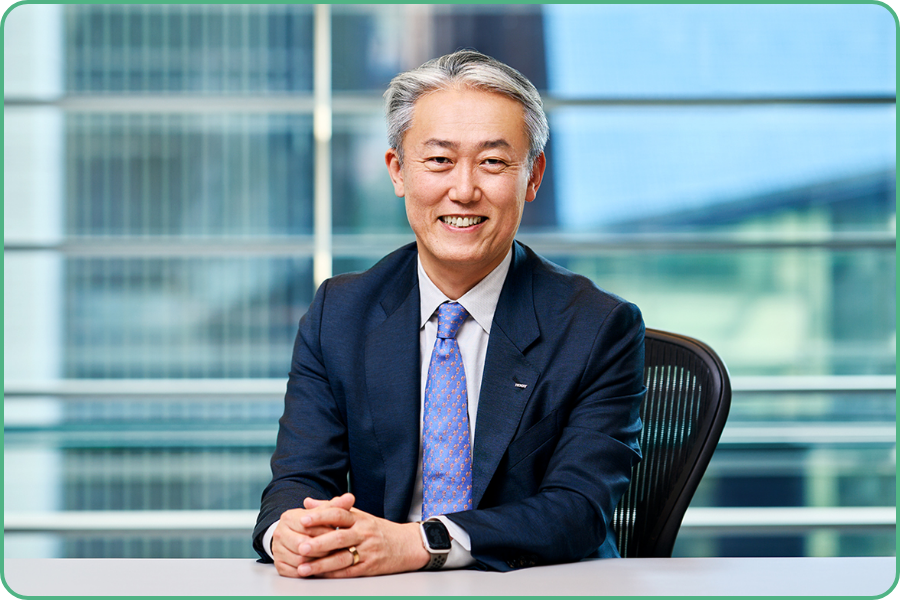
In June 2022, I was appointed as an outside director at HOGY MEDICAL, providing external oversight of corporate management. Two years later, in June 2024, I took on the position of chief financial officer (CFO). In this capacity as an internal executive director, I am now responsible for financial strategy and internal management.
Even prior to my appointment as an outside director three years ago, a primary concern among shareholders was the Company’s suboptimal return on equity (ROE). While our profit margins were reasonably healthy, our asset turnover and financial leverage were inadequate. Specifically, revenue growth relative to total assets was weak, and our equity ratio was comparatively high—both factors contributing to the suppressed ROE. The only way to improve ROE is to grow sales. The challenge, therefore, lies in achieving this growth while sustaining an appropriate level of profitability. Our strategic response has been: strategic investment and improved management visibility.
Driving revenue growth is a challenge. The financial health of our clients, primarily hospital management, remains a concern, and we are consistently presented with diverse requests. However, short-sighted measures alone will not ensure the long-term stability of either our operations or those of the hospitals we serve. Therefore, we are committed to strategic investments, even those requiring a longer time horizon, while simultaneously enhancing management visibility.
Under the current management team led by President Kawakubo, who has declared this a “Second Founding Period,” more proactive approach to business development is required. While our investments have historically focused on enhancing production capabilities, to ensure Hogy Medical continues to provide solutions tailored to the needs of acute-care hospitals, we must strengthen our human capital and information infrastructure and actively invest in adjacent business domains.
To facilitate these strategic investments, “visualization of management (keiei-no-mieruka)” is critical. We must thoroughly evaluate the financial impact of our initiatives and investments before execution. Effective allocation of resources entrusted to us by our shareholders is our responsibility.
By advancing the “visualization of management”, we also aim to improve our balance sheet. We have already reduced underutilized assets. Furthermore, we are strengthening the monitoring of how existing resources are utilized, and are also strengthening greater discipline in the selection of new investment targets, in order to improve capital efficiency. To institutionalize disciplined investment, we established an Investment Committee and strengthened the investment evaluation functions of our Corporate Planning and Finance departments. Investment proposals are thoroughly discussed internally, and after the deliberation by the Investment Committee, important projects are further discussed and approved by the Board of Directors with a strong sense of commitment.
To promote this initiative, it is also necessary to develop talent capable of investment evaluation. It is not sufficient to simply formulate financial plans—what is required is the ability to accurately understand the business models behind the numbers. To this end, we are strengthening financial planning and analysis (FP&A) functions, especially within our corporate planning and finance divisions, in order to develop personnel capable of managing budgets and evaluating investment opportunities. Financial specialists are essential infrastructure for advancing management visualization, and we will continue to prioritize their development.
Strengthening the Human Capital Foundation to Drive Business Strategy Execution
As CFO, my primary focus is to enhance visibility across all our commercial activities, ensuring data-driven decision-making at every level. Within the Commercial Division, which reports directly to the President, we are actively implementing initiatives to drive revenue growth. These include sales organization reforms, product strategy realignment, and, looking ahead, strategic investments in R&D to foster technological innovation.
My role as CFO is to ensure that all these activities are underpinned by clear, accessible data. We are building a mechanism to capture leading indicators of future sales and potential losses directly from the field. This data will be analyzed and fed back into the organization for management decision making. Our goal extends beyond mere data management. We aim to create an environment where each layer of our commercial organization—front-line sales teams, branch managers, and department heads—can effectively implement PDCA cycles. This will involve using data insights to refine sales activities, optimize talent allocation, and enhance promotional strategies.
Achieving this requires a shift in mindset, particularly among our front-line employees. We are committed to fostering this change through ongoing engagement and education. While this will take time, we believe that embedding this data-driven approach throughout the organization is essential for sustainable growth and success.
It is the corporate planning and finance divisions that will take the lead in promoting these front-line improvement efforts through PDCA. In Corporate Planning, we are focusing on developing talent who can engage in data-driven discussions with business units such as Sales and Production. To deepen discussions and derive clear conclusions based on an accurate understanding of the causal relationship between business activities and financial data, coordination between corporate planning and finance is essential. Hence, in the finance division, we are working to develop professionals who can engage in financial discussions with business units and provide support from a financial perspective.
In Procurement, a more proactive approach is required in identifying and negotiating with suppliers. What matters is not simply minimizing costs, but building sustainable, mutually beneficial relationships. To strengthen the procurement strategy, I have placed newly hired sourcing specialists under my direct oversight.
In our factories, our focus is to optimize costs and improve productivity. This requires collecting a range of data—from production costs and personnel allocation to downtime. This data will enable us to set and monitor KPIs at the floor level, empowering each team member to make autonomous, data-driven decisions.
Enhancing Profitability at Overseas Subsidiaries
A key factor in achieving sustainable growth in the future is improving the management indicators of our subsidiaries in Southeast Asia. In both the Sales and Production departments, we are working to improve visibility of business conditions by identifying and leveraging leading indicators.
For the Sales Division, we have been visiting local operations, listening directly to feedback from the field. This enables us to develop budget planning and monitoring systems to effectively drive our strategies. In the Manufacturing Division, the challenge lies in enhancing profitability. Our Indonesian factory produces non-woven fabrics and plastic molded components for surgical kits. However, global price competition is intensifying. Historically, our business model in Southeast Asia has centered on selling long-standing best-selling products in Japan, as well as the latest kit products. However, to further evolve this model, we must identify niche markets where we can leverage our strengths and shift our production focus towards higher value-added products. We are also exploring alternative strategies, such as localized kit manufacturing tailored to regional needs and contract manufacturing for other companies. Overcoming these challenges will improve profitability and facilitate the shift toward a sustainable business model.
We are also considering personnel exchange programs between our Japan-based sites and overseas subsidiaries. We hope that employees at overseas subsidiaries will gain a deeper understanding of the philosophies behind our manufacturing in Japan, and learn how products manufactured in Indonesia are used in Japanese hospitals—so they can apply the knowledge and perspectives gained in Japan to their local production activities. Similarly, we expect our Japanese employees gain valuable experience through the challenges of teaching manufacturing from the ground up, which will, in turn, deepen their product knowledge and enhance their leadership skills.
Challenges for Future Growth and Initiatives Toward New Value Creation
Our strength lies in our ability to consistently stay abreast of the latest information on surgical components and other essential materials, and to reflect improvement requests we hear from healthcare professionals in our product development. To maintain insights up-to-date, our sales representatives visit medical institutions daily, and maintain close contact with the front-line operations. This field-oriented approach has earned the trust of our customers—some of our representatives are even consulted on fundamental hospital management issues, such as improving profitability through better operating room efficiency or ways to train nurses. These deep touchpoints with medical front-lines and our ability to propose timely solutions to the challenges originated as part of our sales activities. However, they hold potential to evolve into new, monetizable service—and we are confident that these services will be highly valued by our customers.
Digital Transformation (DX) is crucial for the development of the new services. For example, while the data from “Opera Master”—our system that supports hospital management improvement—is currently managed and utilized individually by each hospital, analyzing the aggregated data may bring value not only to individual hospitals but also to the entire regional healthcare systems.
HOGY MEDICAL is no longer just a manufacturer of medical components—we have become an essential partner supporting the management of healthcare institutions. We are committed to fostering a shift in mindset among our employees, encouraging them to recognize and embrace the value they provide at a higher level.
As we enter our Second Founding Period, discussions aimed at creating new value have begun to gain momentum across various areas. I firmly believe that pursuing a top-down approach during this period of transformation would stifle the initiative of our middle management. Our middle management, with their passion and flexible thinking, generate ideas and propose concrete business plans at management meetings, focusing on what services we can offer to address our customers’ challenges. The management team then evaluates their level of commitment, allocates resources, and support them. Building this kind of relationship is what I believe is essential during this period of transformation.
Advancing Strategic Investment Alongside Enhanced Shareholder Returns to Drive Further Growth
To our shareholders and investors, we are committed to enhancing shareholder value through increased dividends and executing share buybacks. At the same time, we recognize that growth of the Company itself is essential for sustained stock price appreciation. While prioritizing shareholder returns, we intend to allocate existing cash and future earnings to growth investments aimed at our business expansion. We are committed to providing clear explanations to our shareholders and investors to ensure a thorough understanding of our intent and approach of these investments.
Our investment focus has been on hardware, such as production facilities. Moving forward, we are considering shifting our focus to enhancement of services and products, supply chain reforms, and strategic partnerships—including M&A. By fostering a more open corporate culture and strengthening collaboration with external partners, we aim to further enhance the value we deliver to our customers. Our goal is to embark on bold, strategic investments while simultaneously steadily accumulate short-term results.
We are embarking on our Second Founding Period—a time of transition and transformation. Our medium-term management plan outlines our Vision for 2035, but I believe the specific path to achieving that Vision should not be determined solely by the management team. Instead, it should be shaped by the collective will and passion of our employees, who are committed to realizing that Vision. I want to emphasize that we are focusing our efforts to foster that passion. We are currently in a phase of promoting sales reform and culture transformation, to create mechanisms that encourage employees to generate creative ideas. While the resolution of our Vision may still be low at this point, we are confident that as employee awareness grows, a clearer strategic direction will come into view.
Our mission to continuously provide high-value products and solutions to the healthcare industry remains unchanged. As hospitals face increasingly challenging environment healthcare system reforms, labor shortages, and inflation—cost reduction alone is no longer a sufficient response. Our true value lies in providing fundamental solutions to these issues. This is our challenge. HOGY MEDICAL is uniquely positioned—where we can confidently say, “If we don’t, who will?” By fully leveraging our capabilities and elevating our perspective, we will continue to accelerate our transformation.